Tuesday, June 28, 2022

All Around Arkansas: A Return to Boggy Creek


            On Father's Day weekend, my wife and I headed to Texarkana, Texas, to visit my in-laws. Knowing I had written a column on the Fouke Monster, aka the Boggy Creek Monster, and that I had an interest in the mysterious figure, my father-in-law suggested I go to Fouke, Arkansas, (about 20 miles from Texarkana) that Saturday to the Fouke Monster Festival. Always up for a festival, my mother-in-law said she’d go and we were able to persuade my wife to join us.

             But the man who suggested we attend the festival didn't go, opting to stay inside his air-conditioned house and watch the Razorbacks instead of partaking in the Fouke Monster fun.

             So the three of us took the short drive to the small town of Fouke, which on this day was the center of the sasquatch universe. There were hundreds of vehicles in the parking lot of the community center where the festival is held each year. Inside, there were people everywhere, including vendors selling everything and anything with the Fouke Monster, Bigfoot or sasquatch on it. From T-shirts to action figures to movie prop-quality costumes, there was something for everyone.

             I quickly got caught up in the hoopla, buying a “Boggy Creek Monster, Fouke, Arkansas” T-shirt and a decal for my Yeti (the tumbler — not the monster). But I didn’t realize I was making a purchase from one of the celebrities of the Fouke Monster phenomenon, Lyle Blackburn. 

            Blackburn has made a living by writing and selling books and other wares featuring the Fouke Monster, as well as traveling the country giving presentations at Bigfoot conventions. It was only after I gave him $30 for my souvenirs did I hear the fans in line behind me ask for photos and autographs.

            On the opposite side of the building from where the vendors and concessionaires were located where rows of metal chairs full of people watching the 1972 cult-classic film, “The Legend of Boggy Creek.” The screening would be followed by several speakers, including actors from the movie.

            Heading out of town, we stopped at the Monster Mart, which is part-convenience store and part-Fouke Monster museum. While you can purchase the typical gas station fare, Monster Mart items have their famous hairy mascot plastered all over them. My wife and mother-in-law could stand it no more and had to buy themselves and my father-in-law Fouke Monster shirts. My mother-in-law even purchased a couple of homemade monster claw-shaped cookies and a refrigerator magnet. 

            The Monster Mart's one-room museum featured blurry photos and plaster casts of the feet of the alleged beast, as well as movie posters, newspaper clippings and a life-size replica of the monster for photo-ops. Did my mother-in-law and I get a photo? You bet your happy Fouke Monster we did!

            As we left Fouke, we made one last stop — the legendary Boggy Creek — where the monster has been said to roam all these years. It was quite hot at this point in the day, but there were people taking photos and wandering around hoping to catch a glimpse of the famed creature. 

            The monster’s absence might be because he doesn't like socializing or the scorching south Arkansas heat. That Boggy Creek Monster sounds like my kind of guy. We might even become friends, like in "Harry and the Hendersons."

 And to my dear readers, I wish you all a happy and safe Independence Day weekend.

            A sixth-generation Arkansan, Darrell W. Brown is a lover of all things Arkansas. He lives on Lake Norrell in Saline County with his wife, Amy, and two beloved Boston Terriers. You can find him on Facebook and Instagram at AllAroundArkansas.

Thursday, June 16, 2022

All Around Arkansas: Gambling and the Spa City


            From the mid-1920s to the late 1960s, Hot Springs was considered to be the "Las Vegas of the South." Gangsters and tourists, freshly bathed in hot mineral water, roamed the streets to frequent local casinos, bars, restaurants and places of ill-repute (Maxine’s was a favorite). They even bowled together in harmony at an underground bowling alley beneath Central Avenue. (I’ve personally seen it and yes, it’s very cool!)            

            Notorious gangsters like Al Capone, Lucky Luciano and Owney Madden (owner of the Cotton Club in New York City and also co-owner of The Vapors Club in Hot Springs) could be seen at the Southern Club (now a wax museum), the Ohio Club (Arkansas’ oldest bar and home to an amazing burger), The Vapors Club (which became a church and now operates as an entertainment venue) and other clubs on Central and Park Avenues. Capone had his own personal suite directly across from the Southern Club in the Arlington Hotel (Room 443), which was also a favorite choice of lodging of many of the gangsters, as was the nearby Majestic Hotel.

            While gambling was illegal in Arkansas, government and law enforcement officials looked the other way. Many of them made money on the side and also realized that gambling was good for city tourism. While there were attempts by religious leaders and some politicians to end gambling in the city, their efforts were futile.

            By the early 1960s, the Spa City ranked third in the nation for visitors, including many who came during horse racing season and for the illegal but in-your-face gambling opportunities. At one time, Hot Springs had more than 70 establishments offering some form of gambling.  

            But the sounds of slot machines and excited shouting at the tables came to an abrupt end in 1967 when Gov. Winthrop Rockefeller stopped illegal gambling in Hot Springs, ordering Arkansas State Troopers to confiscate the machines and tables and burn them publicly. While the bathhouses and race track were still popular, the end of gambling almost destroyed the town financially, and many say it never recovered from the glory days.

            With the exception of the Ohio, the old clubs are now gift shops or vacant. The Majestic Hotel burned to the ground in February 2014.

            But the Arlington Resort Hotel & Spa, purchased by new owners in 2017, remains open for guests and is undergoing a $50 million renovation. Oaklawn Racing Casino Resort is more popular than ever now that legal gambling has come to Arkansas; it unveiled a $100 million expansion in 2021 that includes a full casino and resort-style hotel. 

            And Hot Springs is still home to many great restaurants, such as The Porterhouse, The Pancake Shop, and my all-time favorite, McClards’ BBQ. While the clandestine casinos and clubs are long gone, there's still much to see and do in the "Valley of the Vapors."

            If you want to experience the history of Hot Springs gambling, visit the History of Hot Springs Gambling Museum at 3339 Central Avenue, Suite C. The museum was started six years ago by three gambling memorabilia collectors: Lanny Beavers, Chris Hendrix and Tony Frazier, who decided to combine their collections of slot machines, tables, chips and more to create the museum. Inside, you'll also find a collection of vintage Hot Springs memorabilia from clubs like the Southern Club and The Vapors and legendary restaurants like Coy’s Steak House and the Belvedere. Admission is free, but the museum is only open from 10 a.m. to 6 p.m. on Fridays and Saturdays.

        The museum's owners are hospitable and love to share their knowledge of Hot Springs’ past. Every machine is free to play, but unfortunately, you don’t get to keep any winnings. That stays with the house. Doesn’t it always?

        A sixth-generation Arkansan, Darrell W. Brown is a lover of all things Arkansas. He lives on Lake Norrell in Saline County with his wife, Amy, and two beloved Boston Terriers. You can find him on Facebook and Instagram at AllAroundArkansas.


All Around Arkansas: Arkansas' State Flag


             Just like the other 49 states, Arkansas has many state symbols. We have a state bird (mockingbird), a state tree (pine), a state flower (the apple blossom) and a state seal.

            Most of these symbols were created by some state legislator with not much else to do. But there is one state symbol created out of necessity, and it’s one that you probably see every day — the Arkansas state flag.

             Although Arkansas became the 25th state of the union in June 1836, it didn’t have an official state flag until February 1913. The U.S. Navy had built a battleship named the U.S.S. Arkansas, and the Pine Bluff chapter of the Daughters of the American Revolution voted to present the official colors of the state to the commandant of the ship. There was just one problem — Arkansas had no such flag for the ladies to present.

             Apparently, no government official (or any Arkansan for that matter) felt the need for Arkansas to have its own flag. So the women contacted Arkansas’ then-Secretary of State, Earl Hodge, about their organization sponsoring a contest for an official state flag. Hodge gave his blessing and agreed to be the custodian of the entries.

             The contest received about 65 submissions. Some designs were crayon and pencil drawings on paper, while some were miniature flags on silk. Black bears appeared on several entries because Arkansas once had a massive black bear population — so much so that its original nickname before the “Land of Opportunity” and the “Natural State” was the “Bear State.” Humorously, one design featured a wooden fence post with the word "Arkansas" written on it, representing Arkansas’ first settlement, Arkansas Post.

            In early 1913, Hodge and four other judges chose a design entered by Willie Kavanaugh Hocker of Wabbaseka, who just happened to be a member of the Pine Bluff DAR chapter.

            On a red rectangular field, Hocker placed a large white diamond (symbolizing Arkansas as the only diamond producing state) bordered by 25 white stars (symbolizing Arkansas as the 25th state) on a blue band. Her original design had three blue stars in a straight line centered in the diamond. Hocker explained that the red, white and blue colors meant that Arkansas was one of the United States. The three blue stars represented the three countries that Arkansas had belonged to: France, Spain and the United States. The two parallel white stars at the left and right points of the diamond symbolized the dual admission of Arkansas and Michigan to the Union.

            Hocker’s design became the official state flag on Feb. 26, 1913, by a vote of the Arkansas General Assembly. Finally, the U.S.S. Arkansas received its flag from the Pine Bluff DAR chapter.

             In 1924, the state Legislature changed Hocker’s design by adding the word "Arkansas" to the center and placing the three blue stars below it and one above to represent that Arkansas was part of the Confederate States of America. The flag has since remained unchanged.

            There have been few attempts to change the meaning of the Confederate star or to abolish it altogether. But those attempts have been as successful as the Ford Edsel and “New” Coke. You young’uns might have to Google those references.

         A sixth-generation Arkansan, Darrell W. Brown is a lover of all things Arkansas. He served with the Arkansas Department of Parks, Heritage, and Tourism for over six years. Brown lives on Lake Norrell in Saline County with his wife, Amy, and two beloved Boston Terriers. You can find him on Facebook and Instagram at AllAroundArkansas.

Monday, June 13, 2022

All Around Arkansas: Lake Catherine State Park


        Regular readers of this column know my affinity for the Arkansas parks system. Not only did I grow up going to many of them, but I worked for the Department of Parks, Heritage and Tourism for more than six years. I actually worked in a state park (Pinnacle Mountain), and during my time in the tourism division I was able to visit all 52 state parks. Add the fact that my paternal grandfather was in the Civilian Conservation Corps as a young man and helped build several of our state’s first parks, and you could say a love of Arkansas state parks was in my DNA from the beginning.

        One park that my grandfather, Festus Floyd “Bud” Brown, helped build was Lake Catherine State Park, situated along the south shore of Lake Catherine, 13 miles southeast of Hot Springs.

        The park’s namesake was created when Arkansas Power & Light (now Entergy Arkansas) dammed the Ouachita River with the Remmel Dam, which was completed in December 1924. The dam was named after Col. Harmon Remmel, who helped AP&L founder Harvey Couch get a permit from the federal government to dam the river. Lake Catherine was named for Couch’s daughter.

        With a donation of 2,220 acres from Couch and AP&L to the state of Arkansas, Lake Catherine State Park was one of the original four state parks built in the Natural State in the mid- to late-1930s, along with Petit Jean, Devil’s Den and Buffalo River, which was absorbed into the Buffalo National River when the federal government’s park was established in 1972. 

        Lake Catherine State Park was built by the young men of the CCC in 1937, and several of the structures they built still stand and are listed on the National Register of Historic Places. During World War II from 1942 to 1945, Lake Catherine State Park served as a satellite facility for wounded servicemen from the U.S. Army and Navy hospital in downtown Hot Springs. In 1943, German prisoners of war were brought in to complete structures left unfinished by the CCC after the federal government diverted resources to the war effort.

        The park has 20 fully furnished cabins and 70 hook-up campsites, six primitive tent sites and one Rent-a-Yurt. A word of advice — if you’re looking to stay in one of the park’s rustic cabins or even camp, be sure and check availability first by calling the park’s visitors’ center at (501) 844-4176. Both the cabins and campsites tend to fill up quickly, especially during the summer.

        Park interpreters offer hikes, guided lake tours and other interpretive programs year-round. Along with camping and lodging, the park also offers a launch ramp, pavilion, several picnic sites, a swimming beach, playgrounds and three hiking trails. One of the most photographed sites in the park is located at the end of one of those trails — the Falls Creek waterfall, which is especially beautiful after a hard rain.

        The park also operates the only full-service marina on Lake Catherine. There you can purchase boat fuel, bait, snacks, drinks, sunscreen and everything you'll need for a day on the water. Pontoon and fishing boats can be rented at the marina, along with kayaks, canoes and pedal boats.

        When I worked at parks and tourism we had a slogan that appeared in marketing materials and even on bumper stickers: “Go play in your own backyard!” Amid high gas prices and inflation, many Arkansans will no doubt be playing in their own backyard this summer, and I can’t think of a better place for a “staycation” than beautiful Lake Catherine State Park, one of the true gems of Arkansas’ state park system. I’m sure my grandpa would agree.

         A proud sixth-generation Arkansan, Darrell W. Brown is a lover of all things Arkansas. He lives on beautiful Lake Norrell in Saline County with his wife, Amy, and two beloved Boston Terriers. You can find him on Facebook and Instagram at AllAroundArkansas.

Monday, June 6, 2022

All Around Arkansas: The Battle of Jenkins' Ferry


            Several years ago while reading a book about my family’s genealogy, I found that one of my distant ancestors fired the first shot at Fort Sumter, South Carolina, which many historians consider to be the inaugural action that started the War Between the States.

             The man’s name was Edmund Ruffin, and as the oldest member of the South Carolina Palmetto Guards, he was given the “honor” of firing the first shot in April 1861 from a 64-pounder cannon. This, along with my love of American and Arkansas history, sparked my interest in the Civil War.

             I began to take a closer look at Civil War battles fought in the Natural State and took many road trips searching for battlefields, cemeteries and historical markers. One of those trips took me to the site of one of the bloodiest battles of the war in Arkansas: Jenkins’ Ferry Battlefield State Park. The battle of Jenkins’ Ferry started on the morning of April 29, 1864, about 9 miles east of Leola (Grant County).

             The land where the battle was fought was first settled by Thomas Jenkins, who started a ferry across the Saline River in 1815. Jenkins paid the Saline County Clerk just $1 to operate the ferry and charge travelers to cross the river. The ferry was operated by his sons, William and John, until the Civil War began in 1861.

            In March 1864, Union Gen. Frederick Steele led 14,000 troops out of Arkansas’ capital city of Little Rock to join the Union army’s Red River Campaign (sometimes referred to as the Camden Expedition). The goal of the campaign was to unite with Union Gen. Nathaniel Banks’ troops in north Louisiana to invade the state of Texas.

            Steele and his troops successfully seized Camden on April 15, but they didn’t proceed to Louisiana or Texas. Instead, threatened by Confederate soldiers and running low on supplies, Steele chose to return to Little Rock. On the morning of April 29, dealing with the flooded Saline River and aware of the approaching rebel troops, Steele ordered his engineers to create a pontoon bridge at the site of the old Jenkins’ Family Ferry crossing.

             Throughout the night and the next day, the Confederate troops brutally attacked Union forces, resulting in 521 Union casualties and 443 Confederate casualties. Because the Union army succeeded in crossing the river and subsequently destroying the pontoon bridge behind them, the battle went down in the history books as a Union victory. Steele’s troops returned to Little Rock on May 3. Historians estimate more than 2,000 soldiers died in the battle of Jenkins’ Ferry.

             Jenkins’ Ferry Battlefield State Park was created in 1961 by Act 10 of the Arkansas General Assembly and is now is maintained by the state’s Department of Parks, Heritage & Tourism. The 40-acre park consists of several interpretive markers and historic monuments, a section of the original military road, picnic tables, boat ramp and recreational opportunities along the Saline River such as boating and swimming.

            One bit of trivia: The battle is briefly depicted and mentioned by fictional soldiers Pvt. Harold Green of the 116th United States Colored Infantry Regiment and Cpl. Ira Clark of the 5th Massachusetts Colored Cavalry Regiment, who speak with President Abraham Lincoln (played by Daniel Day-Lewis) in the opening scene of the 2012 movie, “Lincoln,” directed by Steven Spielberg.

        While it’s not as famous as Gettysburg or even Pea Ridge, the battle of Jenkins’ Ferry is significant in its own right, as it led to one of the few overall rebel victories (the Red River Campaign) in Arkansas. And as far as my distant ancestor who fired the war's first shot, I’ll leave it to you to find out (in the words of the late radio legend Paul Harvey), the rest of the story.

        A proud sixth-generation Arkansan, Darrell W. Brown is a lover of all things Arkansas. He lives on beautiful Lake Norrell in Saline County with his wife, Amy, and two beloved Boston Terriers. You can find him on Facebook and Instagram at AllAroundArkansas.

Wednesday, June 1, 2022

All Around Arkansas: Three Sisters' Springs


        As I write this, Memorial Day weekend is just a few days away. 

        And as the unofficial start to summer, thousands of Arkansans will flock to our state parks — especially the ones located on lakes — to camp, boat, fish, swim and ski. There's one state park in particular that’s very popular: Lake Ouachita State Park, on the beautiful crystal-clear waters of its namesake outside Mountain Pine. One attraction at the park that often gets overlooked is definitely worth checking out, and that’s the Three Sisters’ Springs.

        The story of Three Sisters’ Springs begins in 1875 when John McFadden set up a homestead on several acres about 12 miles northwest of Hot Springs, a place nationally known for its “healing” and “curative” waters. Located on McFadden’s property were three naturally flowing springs he named the Three Sisters after his three daughters. 

        But in 1883, McFadden, having failed to meet the requirements of federal homesteading laws, lost the land. By the early 1900s, a cunning entrepreneur named W.M. Cecil had taken control of the property, and that's when things began to take off for the three springs and the surrounding acreage.

        Cecil began building a resort he called McFadden’s in honor of the original owner. The resort consisted of several cottages on the hillside, and people would come and relax in the spring waters, hike, swim and fish in numerous nearby streams. (Today, park staff use some remaining McFadden’s cottages as housing.)

        But Cecil didn’t stop there. 

        He decided to build a springhouse over the Three Sisters’ Springs and began bottling the waters he claimed had healing powers. Cecil sold the water, called “McFadden’s World Wonder Waters,” not just at the resort but across the country. 

        According to Cecil, water from spring No. 1 could help cure diabetes, enlarged prostates, insomnia, gout, high blood pressure and arthritis. Water from spring No. 2 was helpful in eradicating chronic constipation and indigestion, low blood pressure, excessive acid and gallstones. And finally, water from spring No. 3 could assist those suffering from chronic diarrhea, eczema, sinus pain and something called catarrh of the head. According to a sign at the springhouse, the cost of water in 1927 was 10 cents per bottle.

        In 1939, the resort and springs were sold to Roy and Ruth Whipple, who would be the property's final private owners. The couple sold the property to the U.S. Army Corps of Engineers' Vicksburg District when Lake Ouachita was completed in 1951. 

        The lake wasn't officially dedicated until 1955 when the hydroelectric plant at Blakely Mountain Dam was finally completed. Shortly after the creation of Lake Ouachita, the Corps of Engineers approached the Arkansas Department of Parks & Tourism about establishing a state park on the shores of the lake not only to provide recreational opportunities to Arkansans but to preserve the Three Sisters’ Springs. The state agreed, and the Corps leased the parks department 360 acres, including the springs for park development.

        Today the Three Sisters’ Springs are free flowing through an area of natural stone over a reconstructed springhouse. The springs are now redirected to flow into one stream that empties into the waters of Lake Ouachita. A sign at the springhouse warns visitors not to partake of the spring waters, as they have not been tested as safe to drink.

        If you go to Lake Ouachita State Park this summer, take your swimsuit, boat, jet ski, fishing pole and bait, but don’t take gallon jugs to fill with water from the Three Sisters’ Springs. We don’t really know what’s in McFadden’s magic water, and it’s best not to take your chances.

A proud sixth-generation Arkansan, Darrell W. Brown is a lover of all things Arkansas. He lives on beautiful Lake Norrell in Saline County with his wife, Amy, and two beloved Boston Terriers. You can find him on Facebook and Instagram at AllAroundArkansas.


Tuesday, May 24, 2022

All Around Arkansas: The Story of the Arkansas Traveler


        If you've lived in the Natural State for even just a few months, chances are you've heard of the phrase "Arkansas Traveler." It applies to a song, story, painting, minor league baseball team and special certificate presented to out-of-state VIPs by the governor and secretary of state.

The origin of the Arkansas Traveler starts with a legend that says Col. Sandford C. Faulkner composed the music and lyrics to a song that became known as "The Arkansas Traveler" after an encounter with a squatter somewhere in the Ozark Mountains around 1840. 

Faulkner was in the area campaigning with several of his friends who were running for various political offices. Supposedly, Faulkner came upon the squatter playing a fiddle tune but was frustrated because he could not finish the piece. The squatter wasn’t very friendly to the strange traveler, but when Faulkner asked for the fiddle and finished the tune, the squatter quickly warmed up to him and even offered him some homemade moonshine. How’s that for Arkansas hospitality? 

Faulkner spun the tale and played the tune all over Arkansas and the surrounding states. But many modern-day historians believe that while Faulkner wrote the tune and came up with the tale, the encounter with the Ozarks squatter never happened. In 1987, the song was adopted by Arkansas' General Assembly as the official state historic song.

In 1856, Edward Payson Washbourne, an artist from Dwight Mission, Arkansas (near present-day Russellville), was inspired by the story and the tune of the Arkansas Traveler and painted the scene from the tale when the traveler meets the squatter. In 1859, J.H. Bufford of Boston made prints of Washbourne's painting. Below the print, the Arkansas Traveler’s melody line appears, as does the phrase, "Designed by one of the natives and Dedicated to Col. S. C. Faulkner," making it clear that Faulkner was the Arkansas Traveler and the author of the story. 

Unfortunately, Washbourne did not get to enjoy the painting’s fame for long; he died in Little Rock in March 1860. No one is sure what happened to Washbourne's original painting, but the Arkansas State Archives claims to be in possession of the restored original.

The Arkansas Traveler is also the name of an award bestowed on notable people who, through their actions, serve as goodwill ambassadors for the state of Arkansas. The certificate features a print of the Arkansas Traveler painting and is signed by the governor and secretary of state. The award was created in early 1941 by the General Assembly and was first presented to President Franklin D. Roosevelt in May 1941.

Probably the most popular use of the term Arkansas Traveler belongs to the Double A minor league baseball team, the Arkansas Travelers. The Travs started play in 1966, and through the decades the team has been affiliated with the Philadelphia Phillies, the St. Louis Cardinals, the Anaheim Angels and now the Seattle Mariners. 

The team's home field from 1932-2006 was the iconic Ray Winder Field, named for the team's first general manager, in Little Rock. In April 2007, the Travelers began play in the new Dickey-Stephens Park in North Little Rock. Sadly, after numerous unsuccessful attempts to save it, Ray Winder Field was demolished. The site now serves as a parking lot for the University of Arkansas for Medical Sciences. 

The term Arkansas Traveler is also the name of a tomato that originated in the early 1900s in the Ozark Mountain, as well as a brand of boat that was produced right here in the Natural State from the 1940s through the 1970s.

There is one more thing known as the Arkansas Traveler, and it's my personal favorite: my pontoon boat. It’s not historic and doesn’t make for an interesting story, but it seems to make family and friends want to visit me more often, especially in the summer. Speaking of summer, I hope all of you dear readers have a wonderful Memorial Day weekend and don’t forget the reason we celebrate.
A proud sixth-generation Arkansan, Darrell W. Brown is a lover of all things Arkansas. He lives on Lake Norrell in Saline County with his wife, Amy, and two beloved Boston Terriers. You can find him on Facebook and Instagram at AllAroundArkansas.


Monday, May 16, 2022

All Around Arkansas: The City That's Twice as Nice


            Growing up in central Arkansas, I can’t remember going to Texarkana unless we were passing through on the way to Dallas or Houston. 

             That changed after I met a native Texarkana girl in 2005, and especially after we tied the knot in 2010. Now I can’t tell you how many times I’ve been to the place that bills itself as the city that’s “twice as nice.” 

             But until a few weeks ago, I didn't know why there’s a Texarkana, Arkansas, and a Texarkana, Texas. My wife didn't know, and neither did my father- and mother-in-law. Thus began my quest to find the answer.

             Texarkana, Arkansas, was founded at the intersection of the Cairo and Fulton Railroad and the Texas and Pacific Railroad in December 1873 and incorporated in Arkansas in August 1880. Apparently, a group of proud Texans (aren’t they all?) wanted a stake in the new city’s action, so they got together and helped form the twin city sister of Texarkana, Texas, which was granted a charter by the Texas State Legislature in June 1874.  

             The city’s name is interesting. It’s a blend of Texas, Arkansas and Louisiana, which is about 30 miles away. But there are other theories as to how the city got its name. One says the city took its name from a steamboat known as the Texarkana, which traveled the waters of the nearby Red River in the early 1860s. Another says the town was named after a medicinal drink called “Texarkana Bitters,” which was sold in the late 1860s at a general store in nearby Bossier Parish, Louisiana.

             While commonly marketed as one city by its chamber of commerce, Texarkana consists of two separate municipalities, each with its own mayor, city council and police, fire, parks and sanitation departments. As the state of Texas does not have a state income tax, residents of the Arkansas side are exempt from Arkansas’ income tax.

             The border between Texas and Arkansas runs along the yellow center line of State Line Avenue in Texarkana. As Bowie County, Texas (named for the legendary hero of the Alamo, James Bowie), is a dry county, several liquor stores line the Arkansas side of State Line Avenue in Miller County (named for Arkansas’ first territorial governor, James Miller). Thirsty customers from Texas seeking adult beverages regularly cross the state line to patronize Arkansas watering holes.

             One famous downtown landmark is known as “Photographer’s Island.” The city is home to a federal courthouse and post office that straddles the two states. The courthouse building is the second most photographed courthouse in the U.S., second only to the U.S. Supreme Court in Washington, D.C. Built in 1932-33, the historic structure features a base of pink granite from Texas and walls of limestone from Arkansas. Photographer’s Island stands in front of the building where visitors can stand in two states at once and is open 24 hours a day free of charge. 

             Some famous Texarkansans include famed composer and pianist Scott Joplin, who was born in Texarkana, Texas, but raised on the Arkansas side. Businessman and 1992 and 1996 independent presidential candidate Ross Perot was born and raised in Texarkana, Texas. Former Arkansas Gov. Frank White was born and raised in Texarkana, Texas, and former Arkansas governor and 2008 and 2016 presidential candidate Mike Huckabee lived several years in Texarkana, Arkansas, as pastor of Beech Street Baptist Church

             So, does the city live up to its motto of being twice as nice? Considering my in-laws and many of my wife’s relatives live there, I would have to say so. It's a great city full of wonderful people and things to see and do. It also doesn’t hurt that the city has the closest Whataburger (my favorite burger chain) to my home in Saline County.

             A sixth-generation Arkansan, Darrell W. Brown is a lover of all things Arkansas. He served several years with the Arkansas Department of Parks, Heritage and Tourism, and worked in all three divisions. He lives in Saline County with his wife, Amy, and two beloved Boston Terriers. Find him on Facebook and Instagram at AllAroundArkansas.


Tuesday, May 10, 2022

All Around Arkansas: North Little Rock's Old Mill


           North Little Rock is famous for many things. It’s where silver was discovered in the 1820s — hence its one-time name of Argenta, which comes from the Latin word for silver. It’s also the home of the Arkansas Travelers baseball team (at least for now) and the Arkansas Inland Maritime Museum.

            But the city is probably most famous for being the home of the legendary Old Mill.

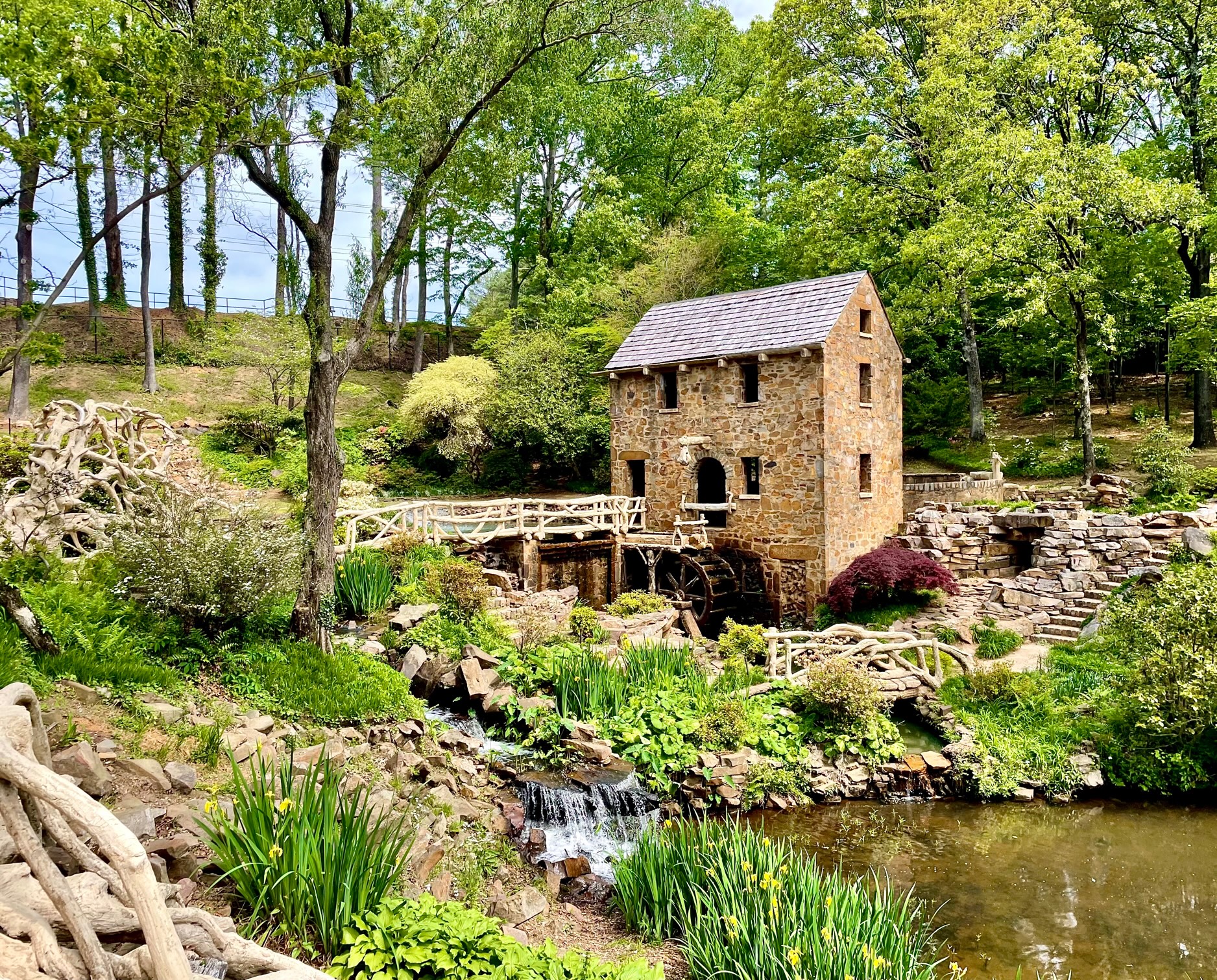
            Through the decades, the Old Mill has been the site of thousands of weddings and the subject of countless photographs. While many believe it’s an actual old mill, the truth is that it's a replica of the grist mills that dotted the landscape of rural Arkansas in the late 1800s.

            The Old Mill was the brainchild of real estate developer and businessman Justin Matthews, who was responsible for the development of the Park Hill and Lakewood subdivisions in North Little Rock, as well as the Sylvan Hills community in Sherwood. Matthews also served on the Arkansas State Highway Commission and helped build Highway 107, which runs through North Little Rock and Sherwood, and the old Broadway Bridge.

            Matthews’ company built two other historic structures in central Arkansas: the Roundtop Filling Station and the Sylvan Hills Golf Course, now known as The Greens at North Hills, both in Sherwood.

            Around 1930, Matthews envisioned a working replica of a vintage grist mill and surrounding park as the centerpiece of his Lakewood subdivision in North Little Rock and a tribute to his friend and business partner, Thomas R. Pugh. In fact, the mill's real name is Pugh’s Mill and the surrounding park is the T.R. Pugh Memorial Park.

            Matthews asked his company architect, Frank Carmean, to design the mill and park. In 1932, he hired artist Dionico Rodriguez of Mexico City to sculpt the concrete work that was made to represent wood, iron or stone, and to design the parks' foot bridges, seats and benches.

            Rodriguez was so secretive about the process by which he produced his work that he would mix the products in the trunk of his car and slam it shut if anyone approached him. He was also known to break the jars of his ingredients and remove the labels so no one could copy him. Not even the family members who worked for him knew all his secrets.

            When the Old Mill was completed and officially dedicated by Matthews and Arkansas Gov. Charles Brough in August 1933, Rodriguez briefly spoke with the help of an interpreter. According to a report in the Arkansas Gazette, he told the crowd that the Old Mill and park was "his greatest commission ever in the United States” and that he “used only the finest grade of cement and the best structural steel and copper so the creations would live in the sight of any who may live or visit in this community for centuries.”

             The mill is arguably most famous for being the last remaining structure to be featured in the classic 1939 movie “Gone With the Wind.” The mill appears for about 6 seconds toward the end of the film’s opening credits. No one knows why producer David O. Selznick chose to place the Old Mill in the movie or even how he knew of the structure, but trust me — it’s in there.

            The Old Mill and T.R. Pugh Memorial Park was officially given to the city of North Little Rock as a gift by the Justin Matthews Co. in May 1976 and was placed on the National Register of Historic Places in October 1986. The mill and park are located on Lakeshore Drive in North Little Rock, open to the public free of charge from 10 a.m. to 6 p.m. seven days a week. Weddings can be held there, but one needs to contact the city's Parks and Recreation Department for permission.

            Speaking of Old Mill weddings, as an ordained minister, I’ve performed a few, including for one of my cousins. The ceremony was going smoothly until both rings fell out of my open Bible into the thick grass.

            We had to search for a moment to locate the lost symbols of love. Now the only hidden treasure at the Old Mill is the beauty and wonder that reminds us of Arkansas’ past.

            A proud sixth-generation Arkansan, Darrell W. Brown is a lover of all things Arkansas. He served several years with the Arkansas Department of Parks, Heritage and Tourism, and worked in all three divisions. He lives in Saline County with his wife, Amy, and two beloved Boston Terriers. Find him on Facebook and Instagram at AllAroundArkansas.

Thursday, April 21, 2022

All Around Arkansas: Benton's Royal Theatre


Benton is full of historic structures. There’s the Saline County Courthouse built in 1901, the former office building of Drs. Dewell Gann Sr. and his son Dewell Jr. (now the Gann Museum of Saline Co. History) built in 1893 and the John Shoppach House built in 1852. 

But one building truly stands out as a landmark of a simpler time in Saline’s county seat — the Royal Theatre. With its iconic neon sign and marquee and unique Moderne architecture, the old theater reminds passers-by on a daily basis of the good ol' days.

The theater is located at 111 S. Market St. in the downtown historic district. The Royal Theatre of today is actually part of the massive renovation of an earlier theater, the IMP (Independent Motion Pictures) Theatre, built in 1920. Alice Wooten, the original owner, sold the property to Wallace Kauffman in 1922. Several generations of the Kauffman Family owned the Royal throughout the years. 

From 1948-49, Little Rock architects Frank Ginocchio and Edwin B. Cromwell redesigned the theater. The pair named the renovated theater the Royal after a Little Rock theater they designed several years earlier. The architects repurposed the neon sign and marquee from the Little Rock theater, which had since closed, for the Royal's renovation.

In 1996, actor Jerry Van Dyke (best known for his role as Luther in the ABC comedy “Coach” and as a co-star on his brother’s successful “Dick Van Dyke Show”) purchased the Royal Theatre from the last of the Kauffman family to own it, Randy Kauffman. Van Dyke completely renovated the theater and much of the surrounding block. He also opened the Jerry Van Dyke Soda Shoppe, a candy store, a baseball card store and an antique store in the downtown historic district. The Royal Theatre continued to show moves until 2000. 

Van Dyke sold the theater and the rest of his businesses in Benton between 2000-2001. The Royal Theatre was donated to the Central Arkansas Community Players, which subsequently changed its name to the Royal Players and continues to perform on its stage. Van Dyke died at his ranch in Hot Spring County in January 2018.

The Royal no longer shows movies — the silver screens were removed and the projectors were sold before the transfer to its current owners. Thanks to community support from businesses and residents, the Royal Players worked hard to preserve the theater. Many of its original fixtures are still visible and a doorless safe with IMP embossed on it remains in an upstairs office.

The Royal Theatre was added to the U.S Department of the Interior’s National Register of Historic Places in September 2003. The designation allows the Royal Players to apply for historic preservation grants and low-interest loans to help maintain the building for the citizens of Saline County for years to come.

Unfortunately, not being a Benton native, I never had the opportunity to visit the theater and catch a flick during its heyday. But my wife's law office is just next door, and every time I walk past the Royal I swear I can smell the scent of buttery popcorn. I look at the spaces where movie posters once hung and wonder what it was like in the good ol' days.

A sixth-generation Arkansan, Darrell W. Brown is a lover of all things Arkansas. He served several years with the Arkansas Department of Parks, Heritage and Tourism, and worked in all three divisions. He lives in Saline County with his wife, Amy, and two beloved Boston Terriers. You can find him on Facebook and Instagram at AllAroundArkansas.

Tuesday, April 12, 2022

All Around Arkansas: The Roundtop Filling Station


            There are so many places and buildings in the Natural State that are near to my heart. I’ve always loved the Arkansas State Capitol, the Old State House, Ray Winder Field (which I’ll cover in a future column), Pinnacle Mountain State Park and several others. But there is no building in Arkansas more special to me than the one-of-a-kind old gas station at the southern edge of my hometown of Sherwood — the Roundtop Filling Station.

             The Roundtop Filling Station on US Highway 67 — in what was then North Little Rock — was built in 1936 for the Pierce Oil Co. by the Justin Matthews Co. It is believed the structure was designed by Matthews’s company architect, Frank Carmean. Pierce wanted a station that would attract the attention of passing motorists, so Carmean came up with a design that included a conical-shaped roof with bright red shingles and a weather vane. Throughout the years, many people have described the Roundtop as something out of a fairy tale due to its unique appearance.

             Wallace “Happy” Williford, a senior at Jacksonville High School and employee at another Pierce-owned station in Jacksonville, was asked by the company to operate the new service station. Because he was still a student, Williford paid men to operate the station for him during school hours. He said it was hard to find men who would work for only $3.50 a week.

             For rent, Pierce charged Williford 2 cents per gallon of gas sold. At first, the station had no electric gas pumps, and Williford and his employees had to hand-pump the gas. By 1957, Williford had saved enough money to buy the station for $8,000.

             According to one of Williford’s daughters, her dad would tell stories of how several rockabilly stars would often visit the Roundtop while traveling Highway 67, including Arkansans Johnny Cash, Conway Twitty (who at the time went by his birth name Harold Jenkins) and Sonny Burgess and the Pacers. Williford also said the filling station was a popular hangout for prominent Arkansas politicians such as Arkansas governors Sid McMath and Orval Faubus. The Roundtop was also famous for being the only gas station between Little Rock and St. Louis to have free public restrooms.

             The Roundtop sported many brands throughout its life. It became a Sinclair station around 1940 after the Sinclair Oil Co. bought Pierce Oil. In the early 1950s, Sinclair sold many of its Arkansas stations, including the Roundtop, to the Phillips Petroleum Co., and the station became a Phillips 66-branded station. In the 1970s, it became a DX-branded station and eventually closed in 1981.

             In 1989, Williford put the Roundup up for auction. The winning bidder was North Little Rock businessman George Brown, who planned to renovate the dilapidated building. But Brown died before work began, and in 1999, his heirs donated the station to the city of Sherwood, which had annexed the area in 1975.

             For years, the landmark sat abandoned and was the victim of vandalism and theft. The structure was placed on the National Register of Historic Places in 2008, and in 2010, the Roundtop was featured in “The Last Ride,” a film about the last days of Hank Williams Sr.

             In May 2013, Historic Preservation Alliance of Arkansas named the Roundtop an endangered historic structure. Soon afterward, Sherwood Mayor Virginia Young asked yours truly to lead an effort to save the building.

             In June 2013, Sherwood received a $50,000 historic preservation grant from the Arkansas Historic Preservation Program (AHPP) for the Roundtop's rehabilitation. Private donors and the city provided the matching money for the grant. Taggart Architects of North Little Rock prepared plans for the building’s rehabilitation and PDC Construction of Little Rock was hired as the general contractor.

             The first phase of the project began in April 2014 and consisted of securing and stabilizing the building; replacing almost all the building's studs, which had been damaged by termites; replacing the concrete floors; and installing a new roof. In July 2014, the AHPP awarded the city a second grant of $78,000 to complete the rehabilitation.

             In November 2014, a fire damaged the building’s exterior. The second phase of the project was completed the following January, and the old filling station is now used by the Sherwood Police Department as its Southside Substation. The station’s interior is decorated with antique soda and oil advertising signs and other memorabilia donated by my father, Floyd E. Brown.

             Should you ever want to experience a bit of nostalgia, put on your Johnny Cash playlist and take a drive to the end of Trammel Road in Sherwood. Fortunately, while the gas pumps and low prices are long gone, the many memories of a simpler time remain.

             A proud sixth-generation Arkansan, Darrell W. Brown is a lover of all things Arkansas. He served several years with the Arkansas Department of Parks, Heritage and Tourism, and worked in all three divisions. He lives in Saline County with his wife, Amy, and two beloved Boston Terriers. Find him on Facebook and Instagram at AllAroundArkansas.


Sunday, March 20, 2022

All Around Arkansas: The Little Rock of Little Rock


             When you work the front desk of a history museum in downtown Little Rock, you get a lot of the same questions from tourists, who ask about the best place to eat downtown or whether Bill Clinton visits very much.

             But more often than not, I'd get this one: "Is there really a little rock in Little Rock?”

             Many times I wanted to say, "Why of course there’s a little rock in Little Rock; in fact, you stepped on several in the parking lot!”

             But that wouldn't be the hospitable, Arkansas thing to do. So I would always tell them the legendary tale of the Little Rock, or as the French called it, La Petit Roche.

             The story goes that in April 1722, French explorer Jean-Baptiste Bérnard de la Harpe was traveling up the Arkansas River looking for a large rock bluff that was made of pure emerald — an amazing geological wonder told to him by the Quapaw Indians he encountered along his journey.

             La Harpe and his party found the large bluff, but of course it was not made of emerald. He noted in his journal that the mostly sandstone bluff was home to a large waterfall and several slate quarries.

             La Harpe named this point “Le Rocher Français” (“The French Rock”) and took official possession in the name of France on April 9 by carving the King of France’s coat of arms on a tree at the top of the bluff. Today, that large rock formation in North Little Rock is known as Big Rock and is home to the Fort Logan Roots VA Complex, the University of Arkansas-Pulaski Technical College and beautiful Emerald Park (I wonder how it got its name).

             Coming back downstream, and surely disappointed, la Harpe noticed on the river’s south bank a smaller rock bluff — also not made of emerald — which he called la Petit Roche, or "the little rock." The name first appeared on maps around 1799.

             La Harpe and his party explored the Arkansas River all the way to near present-day Morrilton, but turned around in May 1722 due to illness and supply problems, heading back to the Gulf of Mexico near Biloxi, Mississippi. In December 1722, the French king sent La Harpe to oversee the transfer of Pensacola, in Florida, from the French to the Spanish. Once he completed his assignment in 1723, La Harpe returned to France and died there in September 1765.

             One can visit the same little rock that La Harpe spotted some 300 years ago but it’s a bit smaller. In December 1833, the Little Rock Junction Railway Co. began construction on a railroad bridge, now known as the Junction Bridge, that required part of the little rock to be blasted away. A 4,700-pound chunk of the little rock was taken and displayed with a bronze plaque in front of Little Rock’s city hall for many years, but it's since been returned to a site near the actual little rock.

             In 2010, the city of Little Rock created the La Petite Roche Plaza in Riverfront Park to interpret the city’s history and showcase the bluff that gave the city its unusual name. The city is now planning several celebrations and activities to commemorate the 300th anniversary of la Harpe’s discovery of its namesake.

             So yes, there are many little rocks in Little Rock. But as far as we historians are concerned, there’s only one true little rock — la Petit Roche.

             A sixth-generation Arkansan, Darrell W. Brown is a lover of all things Arkansas. He served several years with the Arkansas Department of Parks, Heritage and Tourism, and worked in all three divisions. He lives in Saline County with his wife, Amy, and two beloved Boston Terriers. Find him on Facebook and Instagram at AllAroundArkansas.


Saturday, March 19, 2022

All Around Arkansas: The Legend of Petit Jean


            We have some amazing state parks here in the Natural State. And of course I have my favorites: Pinnacle Mountain, Mount Magazine, Devil’s Den and Petit Jean.

             To me, Petit Jean State Park near Morrilton is our most beautiful, and it has sentimental meaning: My paternal grandfather, Bud Brown, helped build the park as part of the Civilian Conservation Corps (CCC) in the 1930s.

             If you’ve ever been to Petit Jean, you’ve probably seen the “gravesite” of the park’s namesake, Petit Jean, or "Little John." But who is Little John and how did "he" rank getting a mountain and a state park named for him? There are a few explanations, and I’ll let you be the judge.

             The most popular tale is that in the 1700s a young Frenchman named Chavet asked the King of France to be part of an exploration of the Louisiana Territory and for a grant to claim part of the land. The king granted Chavet’s request.

             Chavet was engaged to a young lady named Adrienne. When Chavet told her of his plans, she asked that they be married immediately so she could join him on the trip. But he refused her request, and told her that when he returned, the two would marry and travel back to the New World.

             Unsatisfied, Adrienne disguised herself as a cabin boy named Jean and applied for a position on her fiancé's boat. She must have had a convincing disguise, because even Chavet didn't recognize her. The crew gave her the nickname of Petit Jean.

             The ship eventually made its way up the Arkansas River to the foot of a large mountain, where it was greeted by local Native Americans. But before the ship was to set sail for France, Petit Jean became ill, suffering from fever, convulsions, delirium and finally a coma.

             Petit Jean's true identity was discovered during her illness, and she confessed her con to Chavet, who forgave her just before she died. The Native Americans built a stretcher and carried her up the mountain and buried her in a grave overlooking the Arkansas River. Many years later, a low mound of dirt was found at the point now referred to as Petit Jean's Grave.

             Another tale is that in the early 1800s, Petit Jean Mountain was known as Impassable Mountain because it blocked passage along the west bank of the river during periods of low water. John Walker, a French pioneer and veteran of the War of 1812, obtained a grant of acreage in the newly acquired Louisiana Territory as part of his military service.

             When Walker filed the petition to buy the mountaintop land, he identified himself as John Walker of Petit Jean Mountain. He was granted the land, and in 1844, when the maps were redrawn, the Impassable Mountain had been renamed Petit Jean Mountain, possibly at John "Petit John" Walker's request.

             Finally, there’s the story that the popularly told tale about Chavet and Adrienne was created in the early 1900s by the William C. Stout Family, who owned two hotels on the mountain. They advertised their resort hotels as romantic places for newlyweds and completely made up the Petit Jean story as a promotional tool.

             In order to lend some credibility to the tale, Stout paid three men in 1912 to go to the mountaintop, break up some rocks, and pile them into a cairn to create the grave of Petit Jean.

             Personally, I know which story I want to believe, but I also know which story is probably true. But I'll let you, dear reader, make up your own mind.

             A proud sixth-generation Arkansan, Darrell W. Brown is a lover of all things Arkansas. He served several years with the Arkansas Department of Parks, Heritage and Tourism, and worked in all three divisions. He lives in Saline County with his wife, Amy, and two beloved Boston Terriers. Find him on Facebook and Instagram at AllAroundArkansas.